
Spider Id Chart
Most spiders you find at home or in the garden are harmless and useful pest controllers. This ID chart helps you narrow down what you’ve found by the web it made (or whether it hunts without one), its size and its markings, then shows likely matches with key features, habitat and whether it’s one of the few species that need caution. It’s a guide, not a definitive identification.
- Free to use
- No sign-up
- Runs in your browser

Spider identifier
Photos from several angles, including the underside, help experts confirm an ID. Don’t handle spiders to identify them.
Spider ID Printables
Printable spider ID chart by web type, a kids’ garden spider spotting sheet, a web-type identification card and a wildlife observation log.
- ID chart (PDF/XLSX)
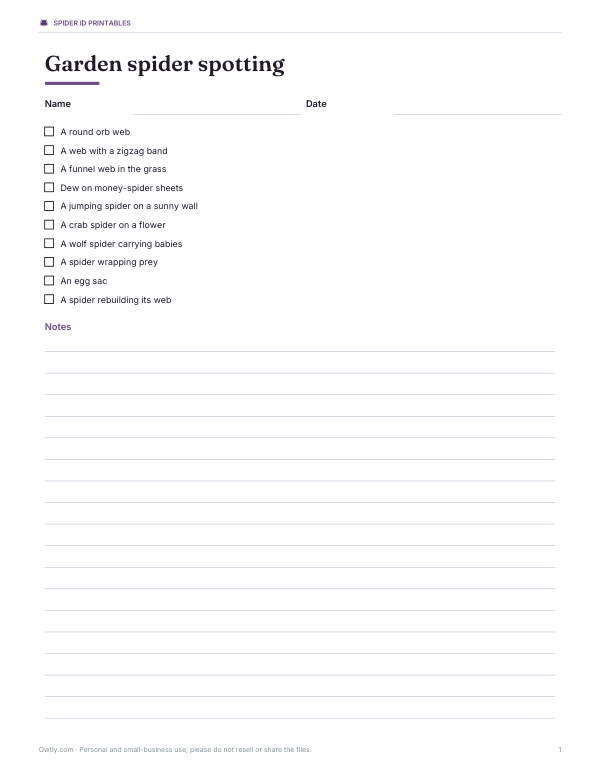
- Spotting sheet (PDF/DOCX)
- Web card (PDF)
- Observation log (PDF/DOCX/XLSX)
Formats: PDF, XLSX, DOCX. Instant download after payment (link valid 72 hours, up to 5 downloads). AI-assisted: the templates were drafted with AI help and reviewed and laid out before publishing.
$5.00 USD, one-time 4 files · about $1.25 each
- Instant download
- 7-day refund
- Secure checkout by Stripe
7-day money-back guarantee. Full refund within 7 days of purchase, even after you download.
Free sample: Garden Spider Spotting (PDF, 67 KB)
Full refund within 7 days — see the refund policy and license.
Free printables
Single sheets you can print right now, no sign-up. The full pack adds every sheet in one download plus the editable files.
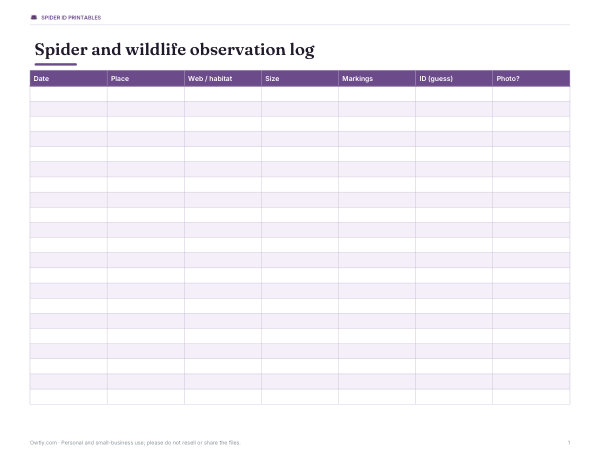 Printable Spider Observation Log
Start with the web
| Web | Who makes it | What it looks like |
|---|---|---|
| Orb (wheel) | Orb weavers | Round web with spokes and a spiral, often rebuilt daily |
| Cobweb (tangle) | Cobweb spiders, widows, false widows | Messy three-dimensional tangle, often in corners or sheltered spots |
| Funnel | Funnel weavers (grass spiders, house spiders) | Flat sheet leading into a tube where the spider waits |
| Sheet / hammock | Money spiders and sheet weavers | Small flat sheets on lawns and hedges, visible with dew |
| Irregular strands | Cellar spiders, recluses | Loose, untidy silk in corners, cellars or undisturbed spaces |
| No web | Wolf, jumping, crab, sac and nursery web spiders | They hunt or ambush prey instead |
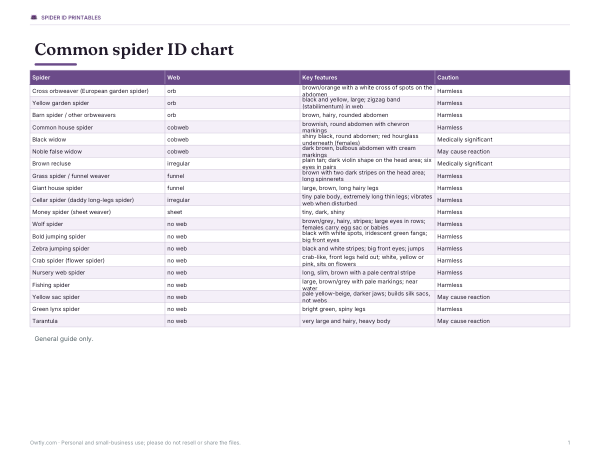
Spider ID chart
| Spider | Web | Key features | Caution |
|---|---|---|---|
| Cross orbweaver (European garden spider) | orb | brown/orange with a white cross of spots on the abdomen | Harmless |
| Yellow garden spider | orb | black and yellow, large; zigzag band (stabilimentum) in web | Harmless |
| Barn spider / other orbweavers | orb | brown, hairy, rounded abdomen | Harmless |
| Common house spider | cobweb | brownish, round abdomen with chevron markings | Harmless |
| Black widow | cobweb | shiny black, round abdomen; red hourglass underneath (females) | Medically significant |
| Noble false widow | cobweb | dark brown, bulbous abdomen with cream markings | Bite may cause a reaction |
| Brown recluse | irregular | plain tan; dark violin shape on the head area; six eyes in pairs | Medically significant |
| Grass spider / funnel weaver | funnel | brown with two dark stripes on the head area; long spinnerets | Harmless |
| Giant house spider | funnel | large, brown, long hairy legs | Harmless |
| Cellar spider (daddy long-legs spider) | irregular | tiny pale body, extremely long thin legs; vibrates web when disturbed | Harmless |
| Money spider (sheet weaver) | sheet | tiny, dark, shiny | Harmless |
| Wolf spider | no web | brown/grey, hairy, stripes; large eyes in rows; females carry egg sac or babies | Harmless |
| Bold jumping spider | no web | black with white spots, iridescent green fangs; big front eyes | Harmless |
| Zebra jumping spider | no web | black and white stripes; big front eyes; jumps | Harmless |
| Crab spider (flower spider) | no web | crab-like, front legs held out; white, yellow or pink, sits on flowers | Harmless |
| Nursery web spider | no web | long, slim, brown with a pale central stripe | Harmless |
| Fishing spider | no web | large, brown/grey with pale markings; near water | Harmless |
| Yellow sac spider | no web | pale yellow-beige, darker jaws; builds silk sacs, not webs | Bite may cause a reaction |
| Green lynx spider | no web | bright green, spiny legs | Harmless |
| Tarantula | no web | very large and hairy, heavy body | Bite may cause a reaction |
Sizes are typical body lengths (not including legs). Many species vary in colour, and young spiders often look different from adults.
Which spiders are dangerous?
Very few spiders are dangerous to people. In North America, the main medically significant spiders are widow spiders (such as the black widow, recognised by the red hourglass under the shiny black abdomen of females) and recluse spiders (such as the brown recluse, with a violin-shaped mark and six eyes in three pairs). In the UK and much of Europe, no native spiders are considered dangerous, though the noble false widow can give a painful bite. If you are bitten and develop spreading pain, muscle cramps, fever, a spreading wound or feel unwell, seek medical help promptly and, if possible, take a photo of the spider.
Worked example: a spider in a round web
You find a spider in a round wheel web between garden shrubs in late summer, about the size of a fingernail, brownish with a pale cross of spots on its back. Choose “Round wheel (orb) web”, “Medium” and type “cross”: the cross orbweaver (European garden spider) is the match — harmless, and busy catching flies. If instead the web was a messy tangle in a woodpile and the spider was shiny black with a red mark underneath, the chart would point to a widow spider, and you should leave it alone.
Tips for identifying spiders
- Observe or photograph from a safe distance; use a jar and card only if you’re confident and wearing gloves.
- Note the web, where it was found, time of year and size (next to a coin in the photo helps).
- Look at eye arrangement if you can — jumping spiders have two huge forward-facing eyes; wolf spiders have large eyes in rows.
- Check the underside for markings such as an hourglass.
- Local natural history societies and online recording schemes can confirm IDs from photos.
Living with spiders
- Spiders eat flies, mosquitoes, moths and other pests.
- To reduce spiders indoors, seal gaps, fit screens, reduce clutter and vacuum webs and egg sacs.
- Outdoor lights attract insects and therefore spiders; use yellow bulbs or motion sensors.
- Wear gloves when moving woodpiles, boxes and garden debris.
- Most spiders run away rather than bite — bites usually happen when a spider is trapped against skin.
Printable spider ID pack
The optional pack includes a printable spider ID chart by web type, a garden spider spotting sheet for children, a web-type identification card and a wildlife observation log. The identifier above is free.
AI-assisted content
This page was drafted with AI assistance and reviewed before publishing. It is a general guide covering common species; identification from descriptions is uncertain. It is not medical advice.
Frequently asked questions
How do I identify a spider?
Note its web, size, colour, markings and where you found it, then narrow down with the chart.
What spider has a red hourglass?
Female black widows (and other widow spiders) — leave them alone.
How do I recognise a brown recluse?
Plain tan body, a dark violin shape near the front, and six eyes in three pairs.
Are house spiders dangerous?
Most are harmless; very few species are medically significant.
Which spiders make round webs?
Orb weavers such as the garden spider.
What should I do if bitten?
Wash the area, apply a cold pack and seek medical help if symptoms spread or you feel unwell.